 da4a1ec23d
Close #1625 Squashed commit of the following: commit a01f12c4e5831c43dbe3ae8a80f4db12077dbb2a Author: ArtemBaskal <a.baskal@adguard.com> Date: Mon Jul 13 15:50:15 2020 +0300 minor commit b8ceb17a3b12e47de81af85fa30c2961a4a42fab Merge: 702c55ed fecf5494 Author: Andrey Meshkov <am@adguard.com> Date: Mon Jul 13 15:32:44 2020 +0300 Merge branch 'feature/1625' of ssh://bit.adguard.com:7999/dns/adguard-home into feature/1625 commit 702c55edc1ba2ab330eda8189498dfff33c92f5f Author: Andrey Meshkov <am@adguard.com> Date: Mon Jul 13 15:32:41 2020 +0300 fix makefile when there's no gopath commit fecf5494b8c1719cb70044f336fe99c341802d25 Merge: d4c811f98a417604Author: ArtemBaskal <a.baskal@adguard.com> Date: Mon Jul 13 15:30:21 2020 +0300 Merge branch 'master' into feature/1625 commit d4c811f9630dee448012434e2f50f34ab8b8b899 Merge: b0a037daa33164bfAuthor: ArtemBaskal <a.baskal@adguard.com> Date: Mon Jul 13 12:35:16 2020 +0300 Merge branch 'master' into feature/1625 commit b0a037daf48913fd8a4cda16d520835630072520 Author: ArtemBaskal <a.baskal@adguard.com> Date: Mon Jul 13 12:34:42 2020 +0300 Simplify sync logs action creators commit eeeb620ae100a554f59783fc2a14fad525ce1a82 Author: ArtemBaskal <a.baskal@adguard.com> Date: Mon Jul 13 11:17:08 2020 +0300 Review changes commit 4cbc59eec5c794df18d6cb9b33f39091ce7cfde9 Author: ArtemBaskal <a.baskal@adguard.com> Date: Fri Jul 10 15:23:37 2020 +0300 Update tracker tooltip class commit 0a705301d4726af1c8f7f7a5776b11d338ab1d54 Author: ArtemBaskal <a.baskal@adguard.com> Date: Fri Jul 10 13:46:10 2020 +0300 Replace depricated addListener commit 2ac0843239853da1725d2e038b5e4cbaef253732 Author: ArtemBaskal <a.baskal@adguard.com> Date: Fri Jul 10 13:39:45 2020 +0300 Validate response_status url param commit 2178039ebbd0cbe2c0048cb5ab7ad7c7e7571bd1 Author: ArtemBaskal <a.baskal@adguard.com> Date: Fri Jul 10 12:58:18 2020 +0300 Fix setting empty search value, use strict search on drill down, extract refreshFilteredLogs action commit 4b11c6a34049bd133077bad035d267f87cdec141 Author: ArtemBaskal <a.baskal@adguard.com> Date: Thu Jul 9 19:41:48 2020 +0300 Normalize input search commit 3fded3575b21bdd017723f5e487c268074599e4f Author: ArtemBaskal <a.baskal@adguard.com> Date: Thu Jul 9 18:20:05 2020 +0300 Optimize search commit 9073e032e4aadcdef9d826f16a10c300ee46b30e Author: ArtemBaskal <a.baskal@adguard.com> Date: Thu Jul 9 14:28:41 2020 +0300 Update url string params commit a18cffc8bfac83103fb78ffae2f786f89aea8ba1 Author: ArtemBaskal <a.baskal@adguard.com> Date: Thu Jul 9 12:55:50 2020 +0300 Fix reset search commit 33f769aed56369aacedd29ffd52b527b527d4a59 Author: ArtemBaskal <a.baskal@adguard.com> Date: Wed Jul 8 19:13:21 2020 +0300 WIP: Add permlinks commit 4422641cf5cff06c8485ea23d58e5d42f7cca5cd Author: ArtemBaskal <a.baskal@adguard.com> Date: Wed Jul 8 14:42:28 2020 +0300 Refactor Counters, add response_status links to query log commit e8bb0b70ca55f31ef3fcdda13dcaad6f5d8479b5 Author: ArtemBaskal <a.baskal@adguard.com> Date: Tue Jul 7 19:33:04 2020 +0300 Delete unnecessary file commit b20816e9dad79866e3ec04d3093c972967b3b226 Merge: 6281084e d2c3af5c Author: ArtemBaskal <a.baskal@adguard.com> Date: Tue Jul 7 19:30:44 2020 +0300 Resolve conflict commit d2c3af5cf227d76f876d6d94ca016d4b242b2515 Author: ArtemBaskal <a.baskal@adguard.com> Date: Tue Jul 7 17:14:51 2020 +0300 + client: Add git hooks ... and 5 more commits

Privacy protection center for you and your devices
Free and open source, powerful network-wide ads & trackers blocking DNS server.
AdGuard.com |
Wiki |
Reddit |
Twitter |
Telegram






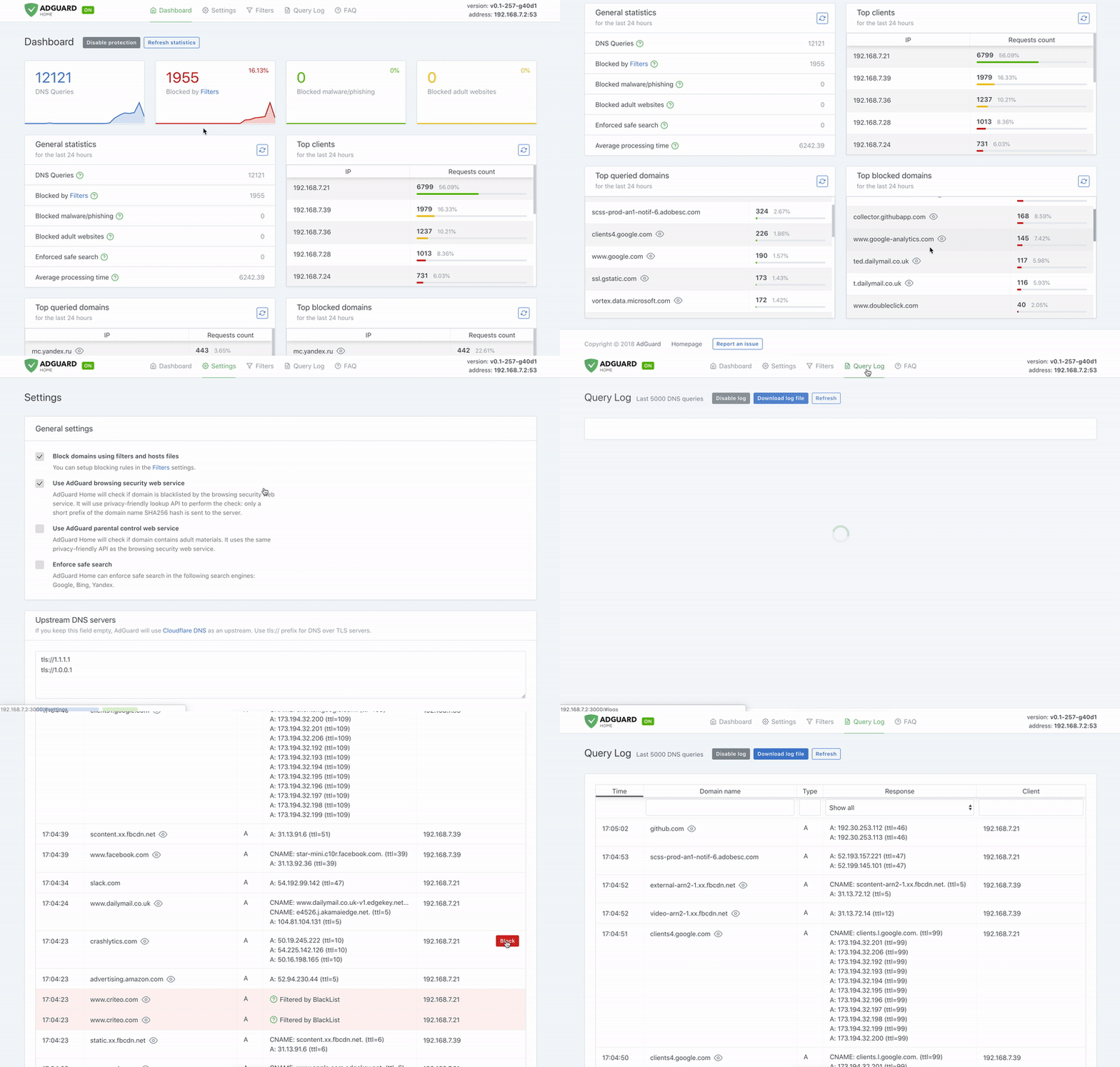
AdGuard Home is a network-wide software for blocking ads & tracking. After you set it up, it'll cover ALL your home devices, and you don't need any client-side software for that.
It operates as a DNS server that re-routes tracking domains to a "black hole," thus preventing your devices from connecting to those servers. It's based on software we use for our public AdGuard DNS servers -- both share a lot of common code.
- Getting Started
- Comparing AdGuard Home to other solutions
- How to build from source
- Contributing
- Projects that use AdGuardHome
- Acknowledgments
Getting Started
Please read the Getting Started article on our Wiki to learn how to install AdGuard Home, and how to configure your devices to use it.
If you're running Linux, there's a secure and easy way to install AdGuard Home - you can get it from the Snap Store.
Alternatively, you can use our official Docker image.
Guides
- Configuration
- AdGuard Home as a DNS-over-HTTPS or DNS-over-TLS server
- How to install and run AdGuard Home on Raspberry Pi
- How to install and run AdGuard Home on a Virtual Private Server
- How to write your own hosts blocklists properly
API
If you want to integrate with AdGuard Home, you can use our REST API. Alternatively, you can use this python client, which is used to build the AdGuard Home Hass.io Add-on.
Comparing AdGuard Home to other solutions
How is this different from public AdGuard DNS servers?
Running your own AdGuard Home server allows you to do much more than using a public DNS server. It's a completely different level. See for yourself:
- Choose what exactly will the server block or not block.
- Monitor your network activity.
- Add your own custom filtering rules.
- Most importantly, this is your own server, and you are the only one who's in control.
How does AdGuard Home compare to Pi-Hole
At this point, AdGuard Home has a lot in common with Pi-Hole. Both block ads and trackers using "DNS sinkholing" method, and both allow customizing what's blocked.
We're not going to stop here. DNS sinkholing is not a bad starting point, but this is just the beginning.
AdGuard Home provides a lot of features out-of-the-box with no need to install and configure additional software. We want it to be simple to the point when even casual users can set it up with minimal effort.
Disclaimer: some of the listed features can be added to Pi-Hole by installing additional software or by manually using SSH terminal and reconfiguring one of the utilities Pi-Hole consists of. However, in our opinion, this cannot be legitimately counted as a Pi-Hole's feature.
| Feature | AdGuard Home | Pi-Hole |
|---|---|---|
| Blocking ads and trackers | ✅ | ✅ |
| Customizing blocklists | ✅ | ✅ |
| Built-in DHCP server | ✅ | ✅ |
| HTTPS for the Admin interface | ✅ | Kind of, but you'll need to manually configure lighthttpd |
| Encrypted DNS upstream servers (DNS-over-HTTPS, DNS-over-TLS, DNSCrypt) | ✅ | ❌ (requires additional software) |
| Cross-platform | ✅ | ❌ (not natively, only via Docker) |
| Running as a DNS-over-HTTPS or DNS-over-TLS server | ✅ | ❌ (requires additional software) |
| Blocking phishing and malware domains | ✅ | ❌ (requires non-default blocklists) |
| Parental control (blocking adult domains) | ✅ | ❌ |
| Force Safe search on search engines | ✅ | ❌ |
| Per-client (device) configuration | ✅ | ✅ |
| Access settings (choose who can use AGH DNS) | ✅ | ❌ |
How does AdGuard Home compare to traditional ad blockers
It depends.
"DNS sinkholing" is capable of blocking a big percentage of ads, but it lacks flexibility and power of traditional ad blockers. You can get a good impression about the difference between these methods by reading this article. It compares AdGuard for Android (a traditional ad blocker) to hosts-level ad blockers (which are almost identical to DNS-based blockers in their capabilities).
However, this level of protection is enough for some users. Additionally, using a DNS-based blocker can help to block ads, tracking and analytics requests on other types of devices, such as SmartTVs, smart speakers or other kinds of IoT devices (on which you can't install tradtional ad blockers).
Known limitations
Here are some examples of what cannot be blocked by a DNS-level blocker:
- YouTube, Twitch ads
- Facebook, Twitter, Instagram sponsored posts
Essentially, any advertising that shares a domain with content cannot be blocked by a DNS-level blocker.
Is there a chance to handle this in the future? DNS will never be enough to do this. Our only option is to use a content blocking proxy like what we do in the standalone AdGuard applications. We're going to bring this feature support to AdGuard Home in the future. Unfortunately, even in this case, there still will be cases when this won't be enough or would require quite complicated configuration.
How to build from source
Prerequisites
You will need this to build AdGuard Home:
Building
Open Terminal and execute these commands:
git clone https://github.com/AdguardTeam/AdGuardHome
cd AdGuardHome
make
Check the Makefile to learn about other commands.
Preparing release
You'll need this to prepare a release build:
Commands:
make release- builds a snapshot build (CHANNEL=edge)CHANNEL=beta make release- builds beta version, tag is mandatory.CHANNEL=release make release- builds release version, tag is mandatory.
Docker image
- Run
make dockerto build the Docker image locally. - Run
make docker-multi-archto build the multi-arch Docker image (the one that we publish to Docker Hub).
Please note, that we're using Docker Buildx to build our official image.
You may need to prepare before using these builds:
- (Linux-only) Install Qemu:
docker run --rm --privileged multiarch/qemu-user-static --reset -p yes --credential yes - Prepare builder:
docker buildx create --name buildx-builder --driver docker-container --use
Resources that we update periodically
scripts/translationsscripts/whotracksme
Contributing
You are welcome to fork this repository, make your changes and submit a pull request — https://github.com/AdguardTeam/AdGuardHome/pulls
Test unstable versions
There are two update channels that you can use:
beta- beta version of AdGuard Home. More or less stable versions.edge- the newest version of AdGuard Home. New updates are pushed to this channel daily and it is the closest to the master branch you can get.
There are three options how you can install an unstable version:
- Snap Store -- look for "beta" and "edge" channels there.
- Docker Hub -- look for "beta" and "edge" tags there.
- Standalone builds. Look for the available builds below.
There are three options how you can install an unstable version.
- You can either install a beta version of AdGuard Home which we update periodically.
- You can use the Docker image from the
edgetag, which is synced with the repo master branch. - You can install AdGuard Home from
betaoredgechannels on the Snap Store.
-
Beta channel builds
- Linux: 64-bit, 32-bit
- Linux ARM: 32-bit ARMv6 (recommended for Rapsberry Pi), 64-bit, 32-bit ARMv5, 32-bit ARMv7
- Linux MIPS: 32-bit MIPS, 32-bit MIPSLE, 64-bit MIPS, 64-bit MIPSLE
- Windows: 64-bit, 32-bit
- MacOS: 64-bit, 32-bit
- FreeBSD: 64-bit, 32-bit
- FreeBSD ARM: 64-bit, 32-bit ARMv5, 32-bit ARMv6, 32-bit ARMv7
-
Edge channel builds
- Linux: 64-bit, 32-bit
- Linux ARM: 32-bit ARMv6 (recommended for Rapsberry Pi), 64-bit, 32-bit ARMv5, 32-bit ARMv7
- Linux MIPS: 32-bit MIPS, 32-bit MIPSLE, 64-bit MIPS, 64-bit MIPSLE
- Windows: 64-bit, 32-bit
- MacOS: 64-bit, 32-bit
- FreeBSD: 64-bit, 32-bit
- FreeBSD ARM: 64-bit, 32-bit ARMv5, 32-bit ARMv6, 32-bit ARMv7
Report issues
If you run into any problem or have a suggestion, head to this page and click on the New issue button.
Help with translations
If you want to help with AdGuard Home translations, please learn more about translating AdGuard products here: https://kb.adguard.com/en/general/adguard-translations
Here is a link to AdGuard Home project: https://crowdin.com/project/adguard-applications/en#/adguard-home
Other
Here's what you can also do to contribute:
- Look for issues marked as "help wanted".
- Actualize the list of Blocked services. It it can be found in dnsfilter/blocked_services.go.
- Actualize the list of known trackers. It it can be found in client/src/helpers/trackers/adguard.json.
- Actualize the list of vetted blocklists. It it can be found in client/src/helpers/filters/filters.json.
Projects that use AdGuardHome
- Python library (https://github.com/frenck/python-adguardhome)
- Hass.io add-on (https://github.com/hassio-addons/addon-adguard-home)
- OpenWrt LUCI app (https://github.com/rufengsuixing/luci-app-adguardhome)
Acknowledgments
This software wouldn't have been possible without:
- Go and it's libraries:
- Node.js and it's libraries:
- whotracks.me data
You might have seen that CoreDNS was mentioned here before — we've stopped using it in AdGuardHome. While we still use it on our servers for AdGuard DNS service, it seemed like an overkill for Home as it impeded with Home features that we plan to implement.
For a full list of all node.js packages in use, please take a look at client/package.json file.